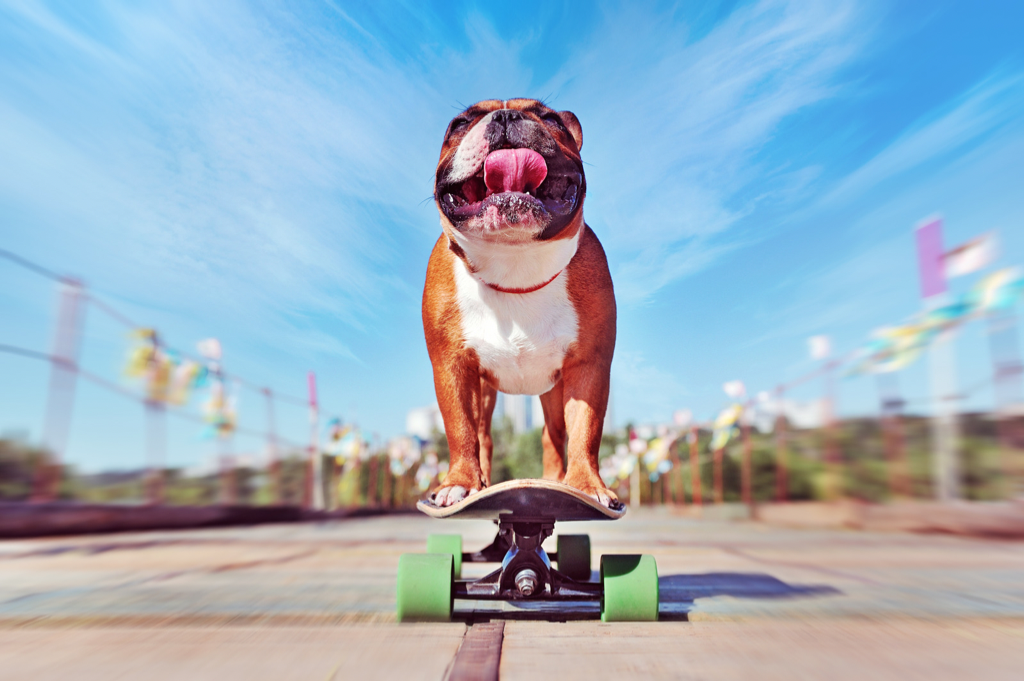
What is the appeal of skateboarding? It's a new trick that is enjoyable and strengthens your friendship. Skateboarding also teaches balance and confidence, which any dog may benefit from.
Skateboarding is an excellent example of dividing behaviors and then chaining them all together in training. Consider it as if you were dividing all of the components in a recipe. Chaining is then like putting the ingredients together in a specific order to make a finished product of skill that can not only be repeated, but that your dog wants to do because it's pleasant for her.
Before you start, make sure your dog is physically capable for this sport. Some free-spirited dogs refuse to be held back by any conventional boundaries. Most dogs should fit the 10-by-30-inch skateboard. However, some breeds might be too large or too big for the standard skateboard and you probably need to either get a bigger board or build a custom skateboard right from the start. Treat the skateboard just as another platform that we use to train animals for centuries. Skateboard is nothing more than a moving platform.
Allow your dog to investigate the skateboard at her leisure. To make it more enticing, place snacks up and around it. The wheels on this 10-by-30-inch skateboard have trainers on them to keep them from shifting.
Allow your dog to freely explore and see how she reacts to the presence of a skateboard in her environment. Slowly is the quickest way for a dog to build associations with anything or learn anything. Begin with a skateboard in a place where you and your dog are both comfortable. You don't have to move the skateboard, and you don't have to spin the wheels. Allow your dog to obtain information about this new piece of equipment on her own and approach it her own way — the old sniff, inspect, and decide method.
Making sure the skateboard does not move at the start is crucial to success. Tighten the skateboard's wheels so they don't spin freely, and also the trucks so the skateboard doesn't sway from side to side. Skateboard trainers can also be purchased to put on each wheel to prevent movement.
We only introduce movement if the dog has mastered getting up on the skateboard and staying on it comfortably. It could take days or hours to complete this task. It is entirely up to the individual dog and how comfortable she is acquiring this new talent.
Use treats to entice your dog to get up on the stationary skateboard. Doing this on carpet or in the grass will prevent unnecessary movement and skidding. You can also do it outside if you have grass, but do not begin on concrete. It will come later, once your dog has gained enough confidence to go on and stay on the skateboard.
Next, encourage your dog to get on the board. If your dog is used to platform training, this should be considerably easier for her, as this is a similar behavior as the platform training. The goal is to develop your dog muscle memory to climb up onto something.
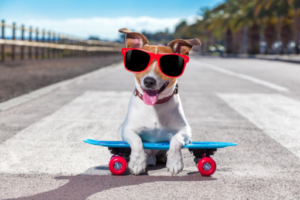
Start with you in front of the board and your dog behind it. Hold something your dog enjoys in your hand to lure her onto the board from the back. Slowly lead your dog to the skateboard and encourage her to step on it. Mark and reinforce her for being on the board once she steps onto it. You can use the verbal cue "load up" to get dogs onto any object in front of them. It is also a great way to get dogs to load up into a car, a stump, a bench, or anything else in their neighborhood that might be amusing to stand on. You can also click for her cue if you have a clicker.
Keep your dog at this stage for as long as it takes her to feel comfortable standing on the skateboard confidently for a prolonged period of time. This can be a brief period for certain dogs because they adapt to this exercise more naturally than another dog. If you force your dog onto the skateboard prematurely, she may never be as comfortable as we want her to be, which is why we tighten up the wheels and trucks in the beginning.
Move on to mobility once your dog is comfortable standing on the skateboard. Loosen the wheels a little at this point to make them go slowly. At this stage, it's still a good idea to keep the trucks tight. This is also the time to transition from carpet to hardwood floor or a backyard patio.
Be patient! Keep your dog in the getting-used-to-the-skateboard stage for as long as it takes for her to feel at ease on the skateboard for an extended period of time.
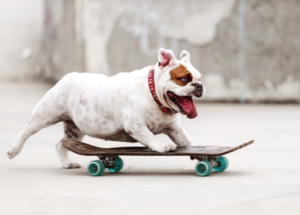
You want to do your best to control the skateboard's movement. One trick is to attach a leash or a rope to the front truck. Pull the dog slowly toward you while on the skateboard, and praise her for staying on the moving skateboard.
This is a critical stage. Enjoy it, and be sure to reward your dog for staying on while the board moves. This requires pushing the skateboard forward a few times while the dog stands on it so the behavior sticks.
Spend enough time for your dog to get used to balancing herself on the less stable board. To extend her balancing skills, slowly rock the board side to side with your hand or foot on it while your dog is standing on the board.
Humans turn a skateboard by shifting their weight either on their heels or toes. Dogs turn a skateboard side to side by leaning their weight to the right or left. It's another critical stage to be patient and give your pooch all the time she needs to master this stage.
The next step is to guide and encourage your dog to move the board with her back legs on her own. Move the board forward with your dog's front legs on the board and her back legs on the ground, creating that "magic" moment for her to realize she can now move the board on her own.
Lure her forward with a piece of her favorite treats or a favorite toy. You want to be far enough away to motivate her to propel the skateboard toward you, but not so far away that she decides to leave her skateboard behind to collect her treats from you. Be flexible at this stage, adjust the distance between you two as needed, and gradually increase it as she gains the skill to move the board herself.
Now that she has mastered staying on her board, move your dog to an environment where she can skateboard safely on her own. Your dog needs to be off leash. It is incredibly difficult and dangerous for her to skateboard with a leash tied to her harness. She could be thrown off balance and the leash could get tangled in the wheels.
Your dog also requires a secure environment in which to further develop her abilities. A patio or a fenced-in backyard or driveway can be a safe controlled environment. Try a local tennis court or even a skate park. Any fenced-in paved area would do.
Remember, it's a process. Each step is an important building block to the next one. Move as quickly as the slowest learner. There is no wrong way to shape a new behavior for your dog, just find the right way that works for her individuality. Both of you should have fun, and neither of you should be stressful. That way your pooch will jump on her skateboard as soon as she sees it. Then we have a WIN!